




Comment broder Spiderweb stitch
Tutoriels de points de broderie > Tous les points > Spiderweb stitch
The Spiderweb stitch, step by step
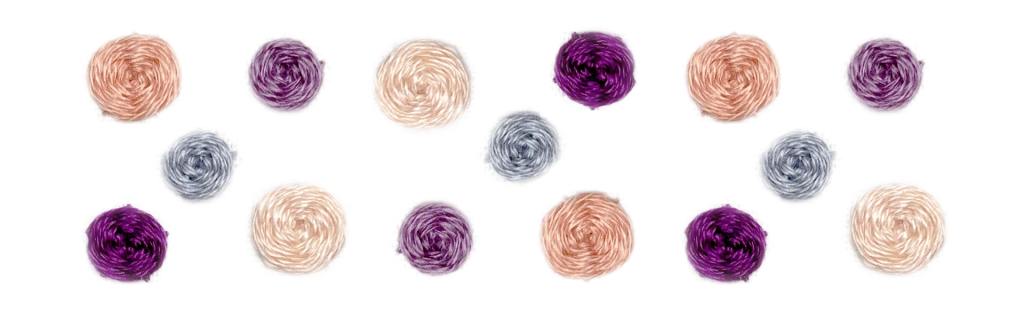
We guide you here, step by step, to embroider the Spiderweb stitch.
The spiderweb stitch is worked by laying a foundation of an odd number of straight stitches arranged as a star, then weaving the thread alternately over and under each spoke to form a dense and even circular wheel.
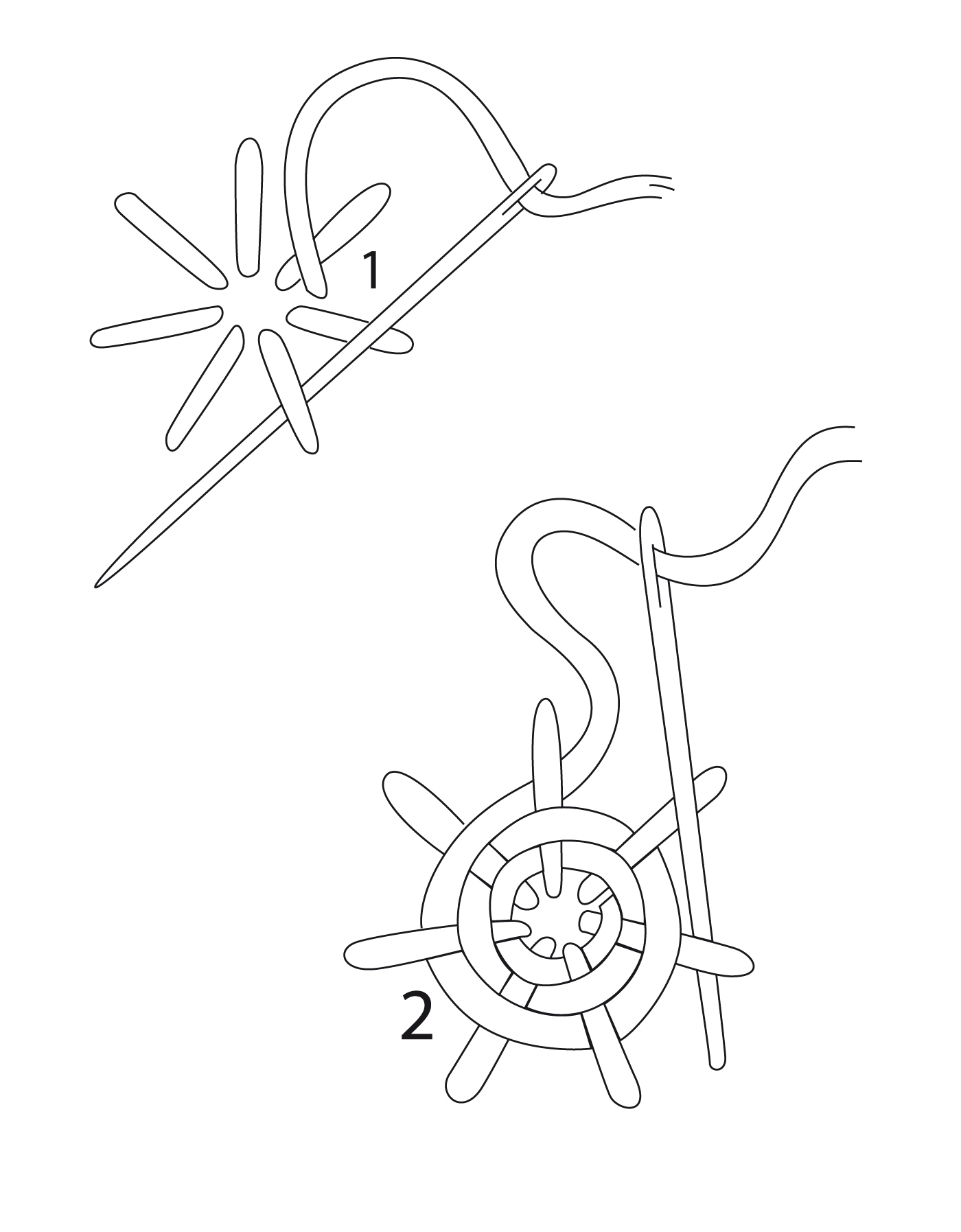
1 – Lay the foundation spokes
Secure the thread on the back of the work inside the circle, without piercing the centre. Bring the needle up at A at the tip of one spoke. Insert the needle at the centre B. Repeat this motion, bringing the needle up at C, D, E and so on, to form a star of an odd number of evenly spaced spokes radiating from the centre.
2 – Prepare the weaving
Bring the needle up between two spokes, as close to the centre as possible. Turn the needle around and use the eye to pass alternately under then over each spoke, without piercing the fabric.
3 – Weave the stitch
Continue weaving around the centre, always passing alternately under then over the spokes. Gradually cover the full foundation without pulling the thread too tight.
4 – Finish the stitch
When the circle is fully covered, insert the needle to the back of the fabric at the edge of the stitch and secure the thread under the previously worked stitches. ___________
FOR RIGHT-HANDED EMBROIDERERS: Work in an anti-clockwise direction.
FOR LEFT-HANDED EMBROIDERERS: Work in a clockwise direction. Tips for a successful spiderweb stitch

Tips for a perfect spiderweb stitch
Number of spokes: Always use an odd number of spokes — this alternation is what allows the weaving to shift naturally from one round to the next and cover the full surface.
Spoke tension: The spokes must be well tensioned and of equal length so the circle is covered evenly.
Weaving motion: The weaving is worked without ever piercing the fabric — turn the needle around and use the eye to slide under the spokes without catching the threads.
Thread tension: Do not pull the thread too tight: thread pulled too tightly causes the rounds to overlap and produces an overly raised effect, while thread that is too loose gives a limp stitch with no structure.
Changing thread: If you need to change thread during weaving, secure the thread on the back and bring the new thread up at exactly the same point, resuming the correct under/over alternation.
Result
On the front: a dense and even woven wheel, fully covered, forming a circular raised motif.
On the back: the foundation straight stitches and the finishing stitches.
EXPLORE FURTHER

The Spiderweb stitch, an essential stitch for learning hand embroidery
The spiderweb stitch is used to represent flowers, rosettes and decorative circular elements in floral and botanical compositions.
It appears frequently in traditional embroidery to create instantly recognisable raised motifs.
The size of the circle and the number of spokes can vary to produce more or less dense and voluminous results.

Spiderweb stitch: a weaving technique worked on a foundation of straight stitches.
Its construction relies on the regular alternation of the thread over and under each spoke, without ever piercing the fabric.
This mechanism produces a dense and structured circular motif that retains a pleasing suppleness despite its volume.
It holds a distinguished place in the repertoire of decorative stitches in hand embroidery.
DISCOVER OTHER STITCHES

Why learn the Spiderweb stitch?
• understand the principle of weaving on a straight stitch foundation
• learn to work on an odd number of spokes to achieve a continuous weave
• control thread tension for an even and well-structured circular motif
• enrich your floral compositions with an expressive raised decorative stitch
Learn the Spiderweb stitch with Un Chat dans l’Aiguille
At Un Chat dans l’Aiguille, the spiderweb stitch is taught step by step with clear, structured guidance.
Our approach to teaching is part of a complete hand embroidery stitch encyclopaedia, designed to support every embroiderer on their journey.
It allows you to progress at your own pace whilst building precision, consistency, and confidence in hand embroidery.