




Comment broder Tube cast on stitch
Tutoriels de points de broderie > Tous les points > Tube cast on stitch
The Tube cast on stitch, step by step
We guide you here, step by step, to embroider the Tube cast on stitch.
The tube cast on stitch is worked by forming loops around a cardboard tube used as a support, producing wide, even and voluminous loops that are ideal for raised flowers.
1 – Prepare the tube
Cut a rectangle of cardboard 2.5 cm tall by 1.5 cm wide. Roll it to form a cylinder 2.5 cm tall. Secure it with tape along its full height, leaving the opening free so the needle can pass through easily.
2 – Work the straight stitch
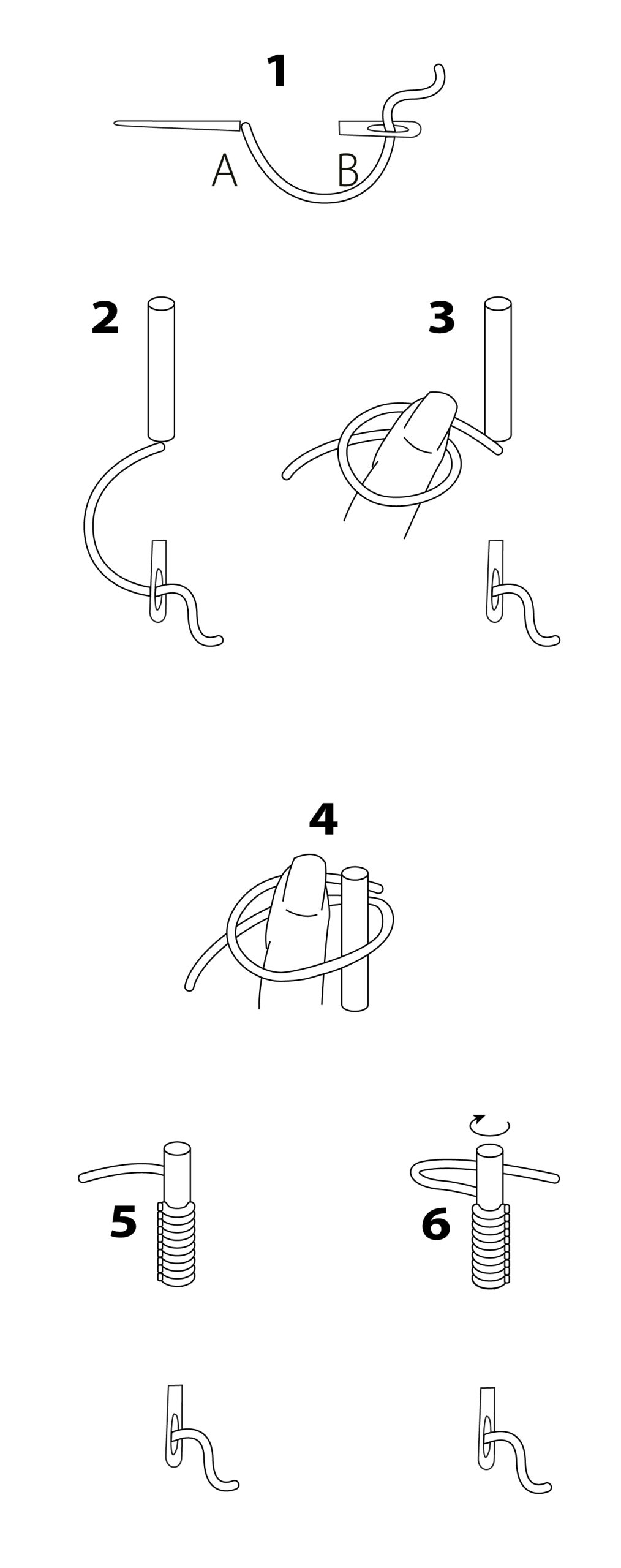
Bring the thread up at A. Insert the needle at B and bring it up as close as possible to A. The distance between A and B determines the width of the stitch. Then slide the needle into the tube, making sure it rests flat on the fabric.
3 – Form the first loop
Slide the thumb under the thread to maintain a slight tension. Pivot the finger towards you while tightening the thread. Maintain the tension and place the finger against the top of the tube. Slide the loop formed around the tube. Pull the thread firmly while adjusting the loop onto the tube. Make sure the first loop stays on the tube — if it slips onto the fabric, it will tighten around the thread when the thread is pivoted and will lose all its relief.
4 – Build the following loops
Repeat the same gesture around the tube until the desired number of loops is reached.
5 – Complete the stitch
Pivot the thread to the back and rotate the tube — the scalloped part now sits on the right. With the left hand, carefully withdraw the tube while holding the loops under the fingers of the right hand. Pivot the scalloped edge downwards and towards B while holding the loops under the fingers. Insert at B to secure the whole stitch. Work the loops with the finger to give them a harmonious, well-defined shape.
6 – Finish the stitch
Pass the thread to the wrong side and fasten it under the stitches already worked. ___________
FOR RIGHT-HANDED EMBROIDERERS: Hold the needle with the right hand and use the left hand to form and cast the loops around the tube.
FOR LEFT-HANDED EMBROIDERERS: Hold the needle with the left hand and use the right hand to form and cast the loops around the tube. Tips for a successful tube cast on stitch

Tips for a perfect tube cast on stitch
Choice of tube: The wider the tube, the larger and more voluminous the loops — adjust the diameter to achieve the desired effect.
Position of the first loop: Make sure the first loop stays on the tube and does not slip onto the fabric — it determines the hold of all the loops that follow.
Thread tension: Maintain an even tension throughout the formation to achieve uniform loops.
Rotation before withdrawal: Before withdrawing the tube, check that the scalloped part is correctly positioned on the left after the rotation — this position ensures a well-formed petal.
Shaping: Adjust the loops with your fingers after withdrawing the tube to achieve an even, well-defined finish.
Result
On the front: a raised stitch made up of wide, even loops, more voluminous than those of the standard cast on stitch.
On the back: a discreet anchor stitch.
EXPLORE FURTHER

The Tube cast on stitch, an essential stitch for learning hand embroidery
The tube cast on stitch is used to create raised flowers with wide, structured petals.
It enriches floral compositions with a voluminous texture in traditional embroidery.
The diameter of the tube directly determines the size of the loops and allows the effect to be varied according to the motif being embroidered.

The tube cast on stitch: a variation of the cast on stitch worked with a cylindrical support.
Its construction rests on the formation of loops around a tube that ensures a height difficult to achieve by hand alone.
This architecture produces well-defined, adaptable motifs according to the diameter of the support used.
It is one of the most expressive techniques in hand embroidery for creating raised, structured floral elements.
DISCOVER OTHER STITCHES

Why learn the Tube cast on stitch?
• understand how a cylindrical support conditions the shape and height of the loops
• develop precision of gesture in forming and withdrawing the loops around the tube
• learn to embrace and celebrate the unique, living quality of each petal
• enrich compositions with raised flowers with wide, expressive petals
Learn the Tube cast on stitch with Un Chat dans l’Aiguille
At Un Chat dans l’Aiguille, the tube cast on stitch is taught step by step with clear, structured guidance.
Our approach to teaching is part of a complete hand embroidery stitch encyclopaedia, designed to support every embroiderer on their journey.
It allows you to progress at your own pace whilst building precision, consistency, and confidence in hand embroidery.