




Comment broder Detached buttonhole border
Tutoriels de points de broderie > Tous les points > Detached buttonhole border
The Detached buttonhole border, step by step
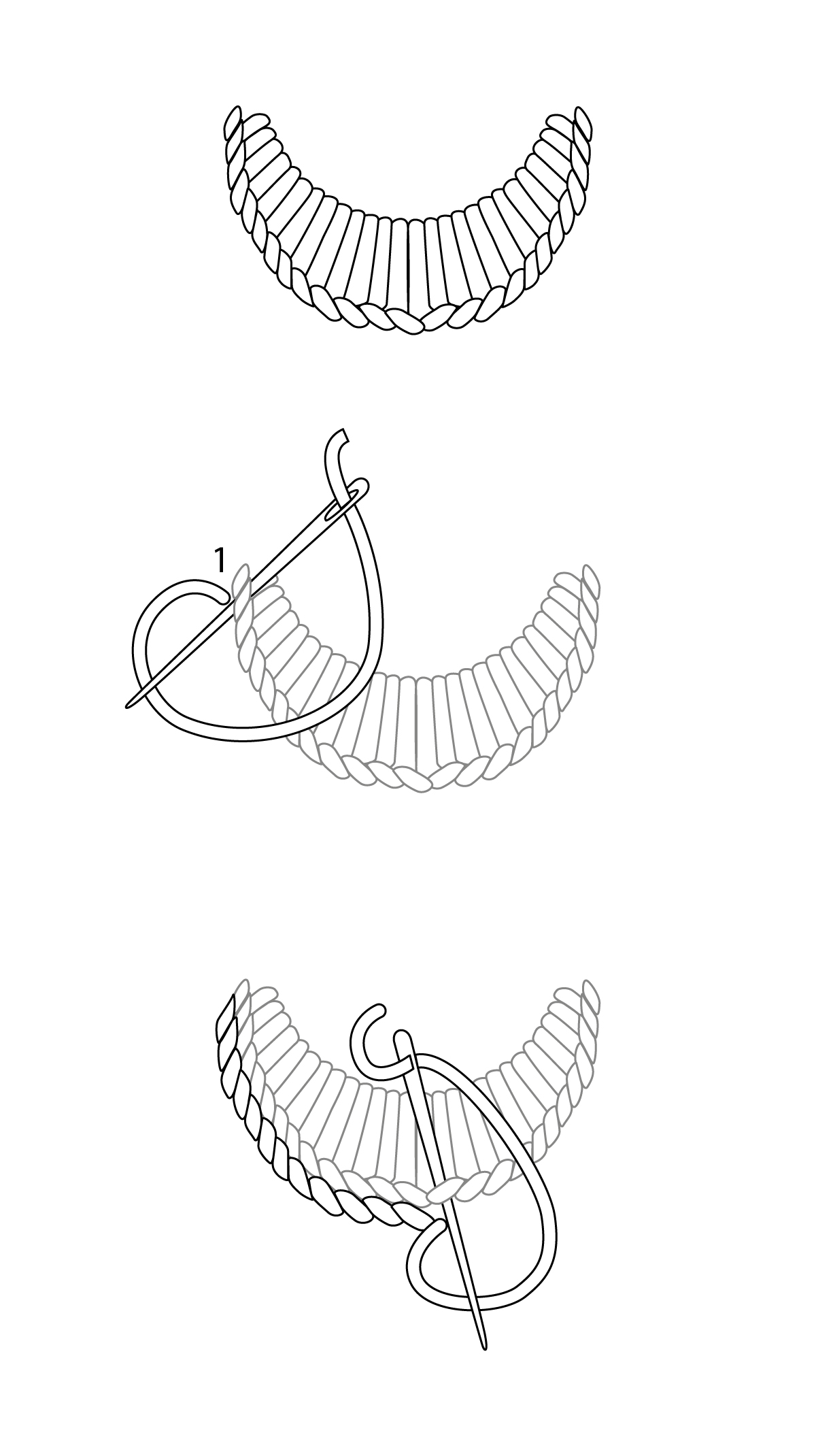
We guide you here, step by step, to embroider the Detached buttonhole border.
The detached buttonhole border consists of forming a line of blanket stitch loops by sliding the needle through the stitches of an existing base — blanket stitch, chain stitch, or stem stitch — without piercing the fabric, to add texture and enrich the motif.
1 – Work the base stitch
Begin by working a line of blanket stitch, chain stitch, or stem stitch. This line will serve as the foundation for the re-embroidered border.
2 – Begin the detached border
Bring the needle up at A on the right side of the fabric, close to the edge of the base stitch line. Keep the thread held down with your thumb. Slide the needle at B through a loop of the base stitch, without piercing the fabric, keeping the thread under the needle tip. Pull gently to form the first blanket stitch loop.
3 – Continue the border
Slide the needle through each loop of the base stitch, keeping the thread under the needle tip. Pull gently after each pass to form the following loops. Continue in this way along the full length of the border.
4 – Add a second line (optional)
Once the first border is complete, you can work a second line of detached blanket stitches by repeating the same gesture to increase the relief. Pass the thread to the back of the fabric and fasten it under the stitches already worked. ___________

Tips for a perfect detached buttonhole border
Thread position: Always keep the thread under the needle tip as you pull through — this is the gesture that correctly forms each blanket stitch loop.
Thread tension: Pull the thread gently and evenly so the loops rest against the base stitch without distorting it.
Needle passage: Always slide the needle through the loops of the base stitch without piercing the fabric — this is what gives the border its detached, raised quality.
Choice of base stitch: This technique works with many stitches — blanket stitch, chain stitch, stem stitch — choose a base stitch with loops open enough for the needle to slide through easily.
Raised effect: To increase the relief and density of the border, work a second line by returning to the beginning of the motif with a new thread or by sliding the thread along the back.
Result
On the front: A raised line of blanket stitch loops that highlights and enriches the base stitch without adding new stitches through the fabric.
On the back: The thread travels mainly between existing stitches with very few new anchor points through the fabric.
EXPLORE FURTHER

The Detached buttonhole border, an essential stitch for learning hand embroidery
The detached buttonhole border enriches any embroidered line by adding relief and texture without multiplying stitches through the fabric.
It is often used to highlight outlines or transform the appearance of a motif in traditional embroidery.
Worked in a contrasting thread, it creates a decorative effect that brings out the base stitch.

The detached buttonhole border: a composite technique in the service of relief.
Its construction is based on blanket stitch loops formed through the stitches of an existing base, without piercing the fabric.
This lightweight technique adds volume and depth to an already embroidered line.
It is particularly valued in hand embroidery for enriching a motif with precision and subtlety.
DISCOVER OTHER STITCHES

Why learn the Detached buttonhole border?
• understand the principle of re-embroidering over an existing base stitch
• develop precision of movement without piercing the fabric
• explore raised techniques in embroidery
• enrich any motif with a decorative border
Learn the Detached buttonhole border with Un Chat dans l’Aiguille
At Un Chat dans l’Aiguille, the detached buttonhole border is taught step by step with clear, structured guidance.
Our approach to teaching is part of a complete hand embroidery stitch encyclopaedia, designed to support every embroiderer on their journey.
It allows you to progress at your own pace whilst building precision, consistency, and confidence in hand embroidery.